January 19, 2026 · 8 min read
Industry GuidesLabels for Preserves and Marinades That Actually Hold Up
Dans cet article
• What resistance to moisture and acidic liquids to look for
• The information you should never leave off a preserve jar
• How to keep labels from peeling off in the fridge
Vinegar and Brine Attack the Label Before the Jar Ships
Picture a small batch of pickled beets, still warm from the canner, loaded onto a delivery pallet. A little brine sloshes over the rim on the final stretch, and by the time the order reaches the store, the front label has gone soft and the ink has smeared into an unreadable blur. That's the risk with any product where liquid and label share the same surface.
A marinade that drips down the jar during filling or transport hits the label before it ever reaches the customer. Untreated paper absorbs the acidic liquid, the ink bleeds, and the label becomes unreadable within days.
The same issue shows up in the fridge once the jar is opened, condensation on the lid runs down the glass and soaks the bottom of the label first.
Acidity compounds the problem over the shelf life of the jar, not just during filling. A vinegar-based brine sits right at the label's edge for weeks or months, and a standard adhesive gradually breaks down under that constant acid exposure, the label can look fine on day one and start lifting at the seams by week six.
What We Recommend for Preserves and Marinades
A synthetic material, polypropylene or vinyl, with a permanent adhesive holds up to humidity and acidic liquids far better than paper, coated or not. That's the starting point for anything canned or pickled.
A varnish or laminate adds another layer of protection against vinegar splashes during filling and against the wipe-down jars get after sterilizing.
Pair that material with a permanent, solvent-resistant adhesive rather than a general-purpose one. The difference shows up specifically where jars get wiped down with a vinegar-diluted cloth after processing, a step a lot of small producers do by hand, and one that quietly strips a weaker adhesive over repeated batches.
Acid doesn't attack the jar. It attacks the label, slowly, from the edge of the seal, long after the batch has shipped.
What CFIA Requires on a Preserve Label
The common name of the product, net quantity in metric units, the ingredient list in descending order by weight, and the name and address of the responsible business all need to appear on the label.
Priority allergens, gluten, and added sulphites must be declared, either directly in the ingredient list or in a separate "Contains" statement. This isn't optional, regardless of jar size.
All mandatory information must appear in both English and French, except the company name and address, which can stay in one language. If your product's durable life is 90 days or less, a "best before" date is also required.
In practice, the ingredient list trips up more small producers than any other requirement. Every component of the brine, vinegar, sugar, spices, salt, needs to be listed in descending order by weight, not just the headline ingredient like "beets" or "cucumbers." A recipe that shifts slightly from batch to batch, common in small-batch canning, means the label needs updating too, not just the marketing copy.
Keeping the Label From Peeling in the Fridge
A homemade or small-batch preserve often goes from a warm counter during canning straight to a cold fridge once it's opened. That sudden temperature swing puts stress on the adhesive, especially if it wasn't chosen with that in mind.
A quality permanent adhesive, applied to a clean, dry jar, is still the best protection. Avoid labeling a jar that's still warm or damp from sterilizing, initial adhesion will always be weaker.
Give the jar time to cool and fully dry before applying the label whenever your process allows it. Even a difference of a few minutes between a jar straight out of the water bath and one that's rested for twenty minutes can change how well the adhesive grabs. If your production schedule doesn't allow that buffer, that's exactly when a cold- and humidity-rated adhesive earns its higher price.
KEY TAKEAWAYS
Skip paper entirely for anything that touches vinegar or brine, go straight to a synthetic material with a permanent, solvent-resistant adhesive.
CFIA labeling is non-negotiable regardless of batch size: common name, net quantity, full ingredient list, business name and address, allergens, and bilingual text.
Let jars cool and dry before labeling whenever your process allows it, adhesion suffers on a warm, damp jar straight out of the canner.
Match the label shape to the jar's real geometry, a shouldered or hex jar often needs a flat label instead of a wrap.
FREE GIFT
Download our free technical spec sheet template
A ready-to-fill template to scope your sector-specific labeling needs.
DownloadFormat Matters Too
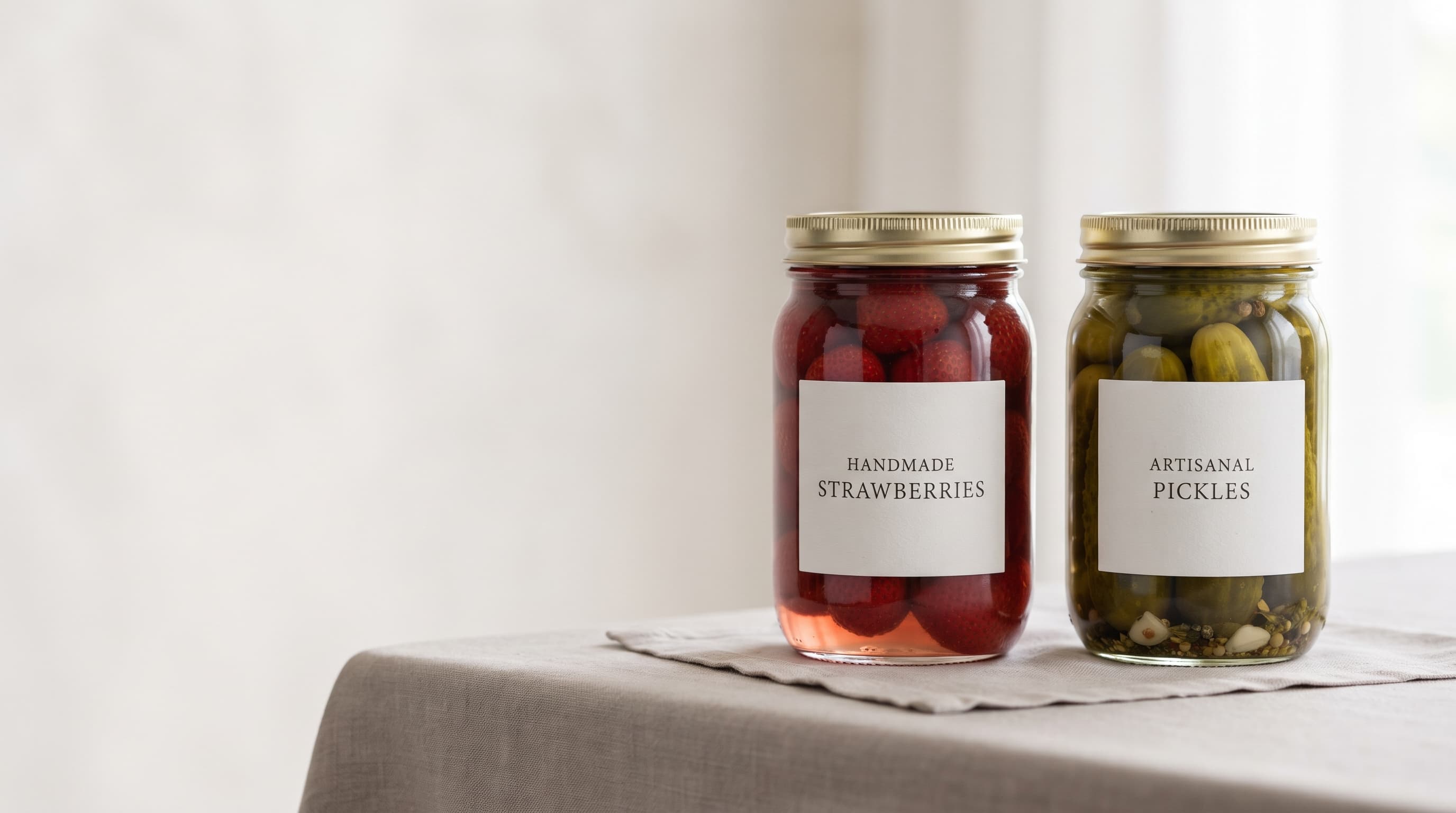
A standard Mason jar has a cylindrical shape that works well with a rectangular or wrap-around label. Leave room for the barcode and mandatory information instead of crowding the front of the jar.
If you sell at markets or specialty grocers, a label that stays clean and legible after repeated handling is worth the investment, it's often the only visual contact a customer has with your product before buying.
A wrap-around label works well on a plain cylindrical jar, but if your jars have a shoulder or a hex-sided body, common with specialty pickle and preserve packaging, a flat rectangular label sits better and avoids the wrinkling a wrap tends to produce at the transition points.