February 9, 2026 · 12 min read
Industry GuidesKitchen Labels: What Survives Heat and Daily Handling
Dans cet article
• Materials that hold up to heat and steam
• How to keep a label readable despite frequent handling
• What to check before ordering your kitchen labels
Kitchen Heat Isn't Warehouse Heat
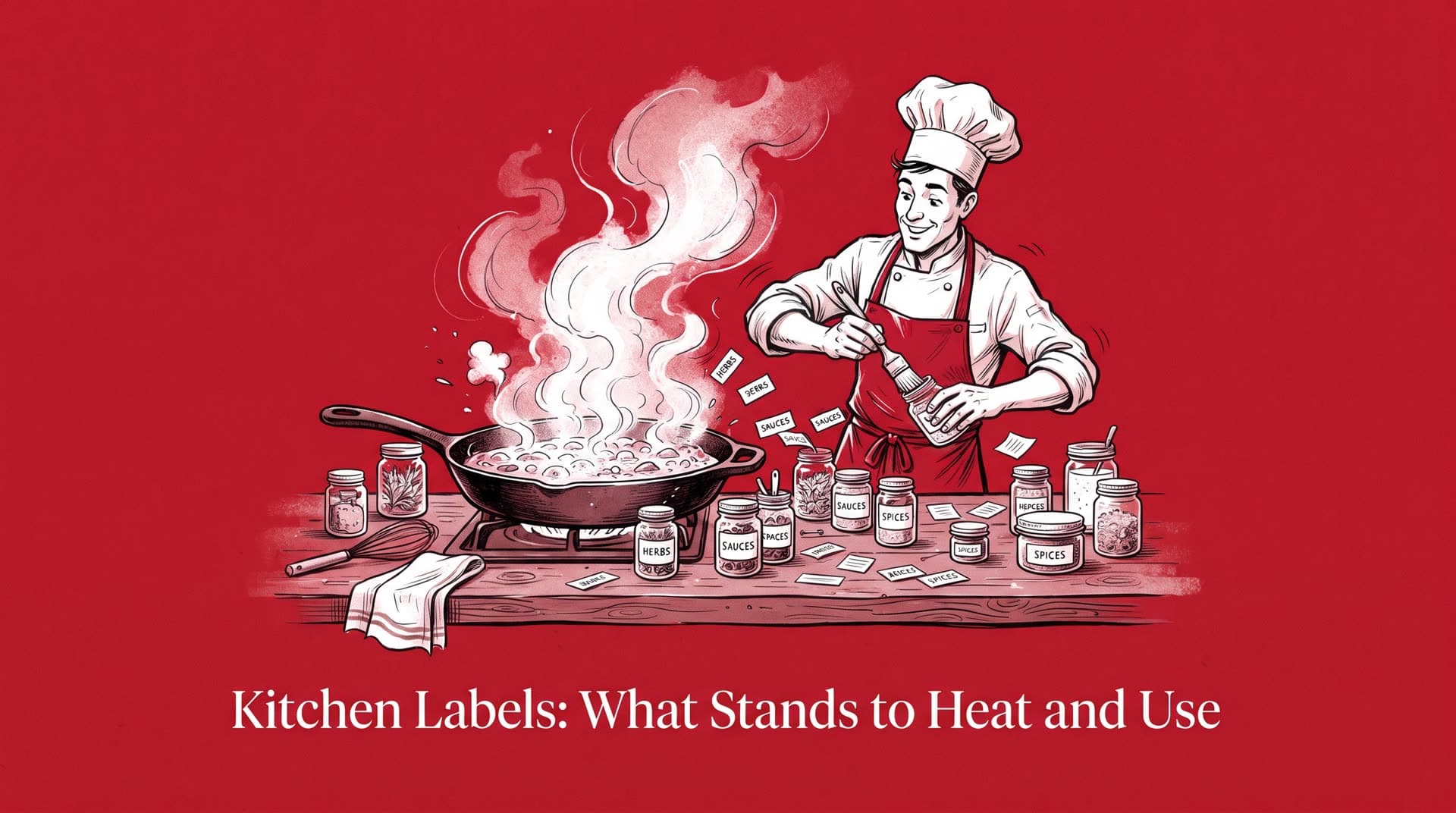
A line cook labels a batch of prepped sauce containers before sliding them into a low oven to hold warm for service. An hour later, the labels have curled off and stuck to the rack instead of the containers, a problem a warehouse label never has to survive.
A label stuck on a container that goes into an oven, sits near a fryer, or runs through an industrial dishwasher takes a different kind of punishment than a warehouse label. Heat, steam, and moisture combined will peel off something that would hold up anywhere else.
It's not just the material that matters, the adhesive has its own temperature limit, often well below the film or paper it's applied to. A standard adhesive that tops out around 80-100°C won't hold up near a griddle or a steam table.
Steam adds a variable that dry heat alone doesn't. A dishwasher or steam table doesn't just raise the temperature, it drives moisture into every seam of a label at the same time, which is a harsher combination than dry heat at the same temperature acting alone.
Choose Based on Actual Use, Not Material Alone
For a container that goes into the oven or gets steam-sterilized, there are materials and adhesives built specifically for dry heat or steam, polyester, reinforced polypropylene, or autoclave-rated adhesives.
Always tell your printer the maximum temperature the label needs to survive, and whether it's dry heat, steam, or both. Getting this wrong costs more in reprints than getting it right the first time.
Polyester in particular handles a wide swing between hot and cold well, which matters for containers that go from a blast chiller to a steam table and back over the course of a shift, a cycle that would eventually defeat a material chosen for heat resistance alone.
Water-Soluble Labels for Traceability
For prep labels, production date, use-by date, employee name, a lot of kitchens use water-soluble labels. They dissolve completely during washing, without leaving glue on reusable bins.
That's a different job than a permanent label; it's meant to come off easily, not stay put indefinitely. Both have their place depending on what you're labeling.
Water-soluble labels also solve a practical labor problem: staff don't need to scrape or soak a bin to remove old labeling before reuse, which speeds up turnover during a busy prep shift and cuts the odds a bin goes back into rotation with a stale date label still half-attached.
Surviving Handling, Not Just Heat
A container handled ten times a day by staff with greasy or wet hands wears down a label faster than a one-time blast of heat. You need a material resistant to abrasion, not just temperature.
Print quality matters too, a direct thermal print fades with heat exposure and repeated rubbing. For a label that needs to stay legible for weeks in a kitchen, a more durable print method is almost always the better call.
Edge sealing matters here too, a label with an exposed paper edge picks up grease and moisture from repeated handling faster than one that's fully laminated or die-cut with a sealed border. On a container handled constantly, that edge is usually where wear starts first.
A container handled ten times a day wears out a label faster than one trip through the oven.
KEY TAKEAWAYS
Match the adhesive's temperature rating to the actual process, dry heat, steam, or both, not just the material on top.
Water-soluble labels are the right call for prep labeling meant to wash off; permanent labels are for anything meant to stay.
Abrasion from constant handling wears out a label faster than a single trip through heat, choose print methods and finishes that resist rubbing, not just temperature.
Test samples under your kitchen's real conditions, and get the technical data sheet, not just the product name, before ordering in bulk.
FREE GIFT
Download our free technical spec sheet template
A ready-to-fill template to scope your sector-specific labeling needs.
DownloadWhat to Check Before You Order
Always test a sample under your kitchen's real conditions before ordering in bulk, the oven, the dishwasher, contact with hot oil, whatever applies to your use case.
Ask your printer for the technical data sheet on the material and adhesive, not just the product name. A spec sheet gives you the real temperature range and saves you from finding the product's limits after a run of several thousand labels.
Loop in whoever actually handles the containers day to day before finalizing the order, not just the person placing it. A kitchen manager might describe a normal wash cycle, while the line cook who blasts trays with a hot degreaser twice a shift knows the real punishment the label needs to survive.